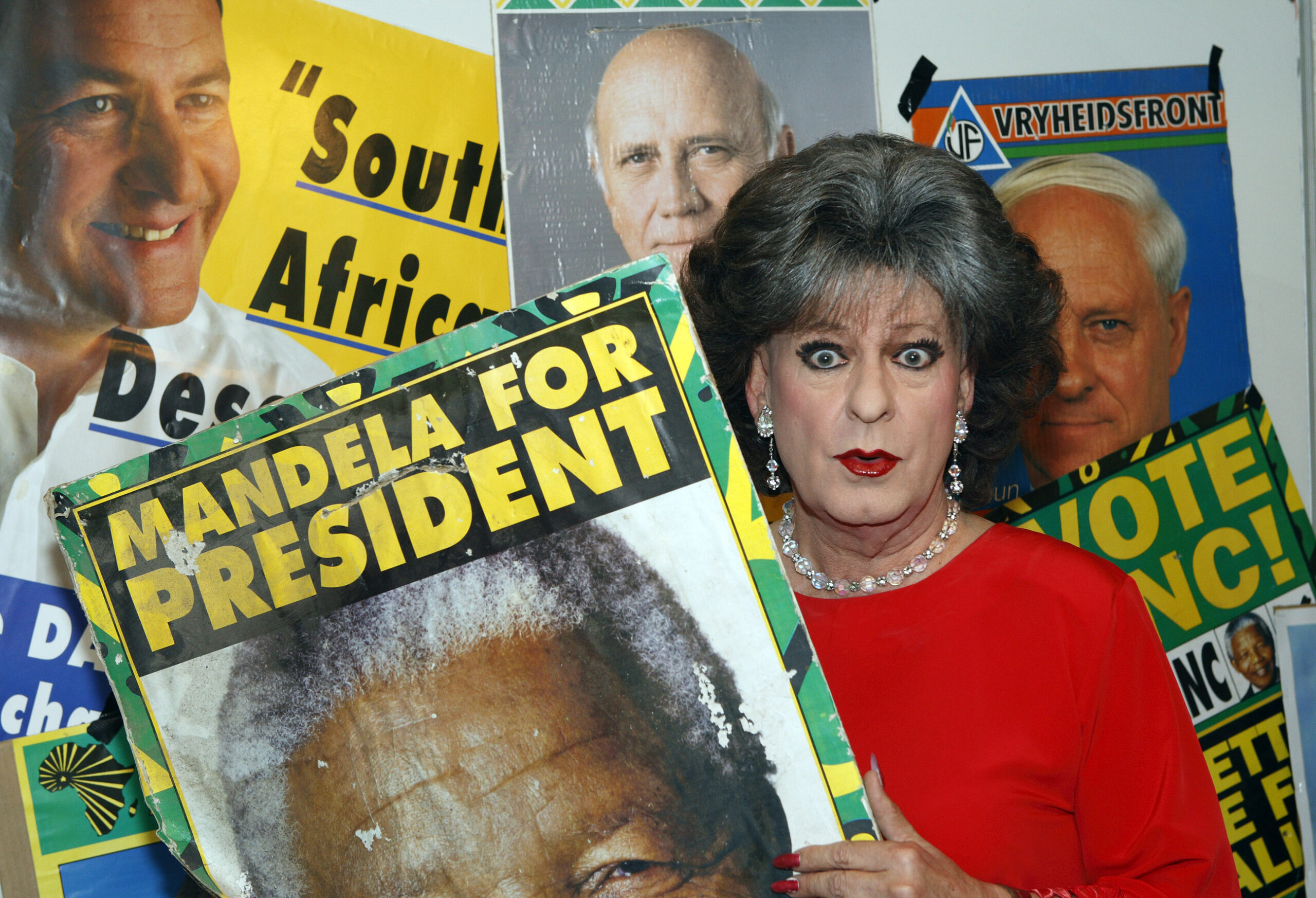
Archived Reviews of Evita for President
REVIEWS OF EVITA FOR PRESIDENT IN CAPE TOWN — NOVEMBER 2007
**** Putting the ‘dent’ into ‘president’
– Derek Wilson, Cape Argus, 13 November 2007
Satirist Pieter-Dirk Uys is on scintillating form again, taking the mickey out of everything in socio-political sight.
In this show it takes him only a few minutes to get the audience eating out of his hand. Immediate, enthusiastic responses greet his cleverly loaded questions, and at the end of the show he receives the greatest accolade a Cape Town audience can give, a partial standing ovation.
He deserves it. His linking patter as he changes from one character to another is up to the minute, and he is clearly aware of what is going on locally and nationally.
If anything, his withering commentary on a number of issues is more abrasive then ever. His sharp wit, applied with scorn and perfect timing, comes to the fore time and time again. He is indeed a skilful performer.
A number of his familiar characters are there, spread over an hour before, and an hour after, interval.
Tannie Evita’s dronkgat jongsus, Bambi Kellermann, is not there, alas. It’s always good to see her getting vrot on stage, only to have Evita come on after her to mop up her sister’s boozy indiscretions. But in this current line-up it probably would not work, given that Uys has a whole panoply of characters to play.
It is instructive to watch him prepare for a coming sketch.
In the past I was never a great fan of the kugel, Nowell Fine, but now this ageing bobbe, now an ANC stooge, is a nail-spitting cynic with increasingly formidable views on anything and everything, particularly her visiting family.
And as Nowell prattles away, she is doing the groundwork make-up for Tannie Evita, who comes on last looking like a million bucks.
In his Evita sketch, in which his Thabo Mbeki doll, comes into play, Uys demonstrates his skilful use of ventriloquism.
His has a delicious new character called Mrs Petersen, and at first I thought he was going down a rocky path to highlight a current infamy, but no: this is another Mrs Petersen who runs a local junkshop where, Uys claims, he buys all that boere-kitsch in Evita se Perron in Darling.
Uys’s take on Adriaan Vlok, which launches Act 2, is another richly observed piece of satire and even Pik Botha comes in for a bit of a going-over.
So too Marthinus “Kortbroek” van Schalkwyk, who was recently described to me as the current Minister of Bags, for succeeding where no one else had, in killing off the National Party.
Uys’s interpretation of Mother Theresa is delightfully irreverent as she becomes a kind of telephonic St Peter in heaven. Even obligatorily offended God-botherers may not be able to stifle a laugh.
But Evita for president?
Sigh … If only …
Uys Continues to Astound
– Wilhelm Snyman, Cape Times, 12 November 2007
A FREQUENT refrain about Pieter-Dirk Uys is that he is always recycling old material, recycling himself and his Evita persona, and that he is, as one put it, “a white liberal trying to panel-beat reality to make himself feel relevant”.
Whether one agrees with these sentiments or not — the fact remains the material he deals with is on the front pages of our newspapers every day or on TV.
The “Aburdistan” that is South Africa has to be addressed and indeed monitored all the time, and here Pieter-Dirk Uys, we know, is searing in his dissection of the contradictions, hypocrisy, self-interest and corruption that bedevil our new South Africa.
“Yes, but he’s got nothing new to say; he was more effective and relevant in the old South Africa”, some may say. Alas, reality would tell us otherwise. Perhaps the old guard provided a more obvious target, they were so much more “lampoonable” and did not have democracy in which to shroud their nefarious dealings.
In “Evita for President” we see an ever-mordant Pieter-Dirk Uys coming up with a very pertinent reminder that in Polokwane in five weeks’ time, the process by a new president is decided upon is itself hardly democratic, with only ANC delegates and branches being able to elect and nominate candidates for the top job.
Here Pieter-Dirk Uys takes out a brilliant Pik Botha impersonation. Pik Botha, apologist some may say for white South Africa overseas in the past, has, as we know, joined the ANC and feels that he should be chosen as the new president. He is after-all a member of the party.
And like many a politician, having the moral universe of a chameleon comes in handy. Pieter-Dirk Uys taps into our anxieties about this process and its outcome, but in this show he doesn’t shy away from showing how his stereotypical icons crumble under the pressure of taking a dignified and morally upright stance in the face of all that is wrong and unjust in our society.
Above all, Pieter-Dirk Uys the artist triumphs. He continues to astound in his seemingly effortless transitions from one character to the next, and making himself up as he spills out one devastating one-liner after another. From Pik Botha he transforms himself into an ex-South African, one Mrs Patel, who has recently resettled in South Africa after a Pakistani family became her next-door neighbours in the UK.
A clever sketch, even though the character may be unfamiliar to many South Africans. But the telling element here is how those who claim to be victims of our ubiquitous crime are themselves the perpetrators of crime.
Another particularly pithy sketch is that of apartheid minister of police Adrian Vlok, significantly sporting a yellow plastic glove, washing Thabo Mbeki’s feet. Mbeki of course is a ventriloquist’s puppet, with decidedly small feet.
When Vlok says that all the Nats were Christians, Mbeki asks him, “why, if you were a Christian didn’t you behave like one when you were apartheid’s minister of police?”
Two sketches that are always fun are his now arch liberal and kugel Nowell Fine, who has had to hire a Vietnamese maid, now that her old maid Dora has become an ambassador.
Nowell’s grandchildren are over from Perth, and as she recounts the details of their visit, she spews out one racist quip after another. The other portrait he sketches sees Uys going into the realm of the after-life as Mother Theresa. Mother Theresa works at the reception in heaven: “press one for God, press two for Jesus Christ, press 3 for the Holy Ghost…”
This is a brilliant sketch, rich in its resonances and one that provides a well-timed counterfoil to the other very localised vignettes. Mother Theresa, with a thing or two to say about the suicide bombers crowding heaven, is preceded by Mrs Pietersen, the Woodstock junk-shop dealer.
She is vintage Uys, and through her he gives voice to the abuses that she has suffered and continues to suffer in another guise in the new South Africa. Tannie Evita, comes in at the end, and with all the sensitivity of linoleum, but she still has her relevance. The question of relevance has everything to do with the kind of society Pieter-Dirk Uys reflects in his shows and the power relationships that operate within it.
While the word “normal” can for the most part only have meaning when written on a washing machine, we’re not a “normal” society, made up as it is of “islands of wealth in a sea of poverty”.
The presidential succession “debate” is all about the candidate who addresses this central dysfunction in our society. Considering the some of the candidates on offer, one should be able to take Tannie Evita’s candidature seriously…
Evita for President
– Gideon Nieuwoudt, iafrica.com, 8 November 2007
You know you’re in for some unusual fair when a play opens with a grumpy old “omie” walking onto the stage with a bucket and a towel, points out a black man in the audience and then proceeds to wash his feet.
Of course, Pieter-Dirk Uys has never been one to shy away from calling a spade on its name, and ‘Evita for President’ is no different.
In fact, it’s probably the most politically incorrect play you’ve ever seen, where nothing is sacred.
Through a host of characters, Uys delivers commentary on the political state of the nation right from the days of Jan Smuts, DF Malan and Hendrik Verwoerd (“they were all airports,” says one of Uys’ characters), right up to the current incumbent president, Thabo Mbeki.
His comic genius finds its most effective release in the political arena, and as a political satirist, Uys is without a doubt on top of his game.
It’s when Uys veers away from politics and enters the land of religion and below the belt jokes that one feels a sense of pointlessness, as this is obviously not his forte and, frankly, quite unnecessarily insulting to people of faith.
You could hear a pin drop as he joked at his own hesitance to make jokes about Muslims, although suicide bombers are not spared. It’s Christianity which takes the brunt of his religious jokes, which unfortunately often degenerated into tastelessness.
However, it’s the political figures of our nation who definitely have to shoulder the weight of his razor-sharp wit, such as Tony “The Butcher of Gugulethu” Yengeni, who “was in jail ever so briefly for telling a white lie about a black car”, and Pik Botha who “didn’t know of any Third Force — I didn’t even know there was a Second Force”.
Surprisingly absent is commentary about Jacob Zuma, the only remark against him worth mentioning being that in 1982 he was “just another terrorist”.
The characters through which Uys delivers his commentary, range from the hilariously funny (such as a bergie who reminisces about the days when he and Trevor Manual used to smoke grass when they were in school together) to characters who could have been dropped in their entirety to shorten the play.
At just under two hours — without any intermission — ‘Evita for President’ becomes a long stretch for both Uys and the audience. By the time Evita finally arrives on the stage 10 minutes before the ending, the whole affair drops into an anticlimax.
‘Evita for President’, however, is not an anticlimax as a whole. It’s got hilarious points, interspersed by moments that might have been better allocated to Mrs Bezuidenhout to extend her part in the play.
Although Tannie Evita’s time on stage is short and a bit of an anticlimax, ‘Evita for President’ is worth watching — if you care for political incorrectness dripping from every word — just to marvel at Uys’ amazing ability to find humour in the political landscape of South Africa, a role in which he is very comfortable, very good, and very well should keep his focus on.
But, in the end, Uys has the last say through his portrayal of Pik Botha: “My conscious is clean, because I never used it.”