Archived Reviews of Evita for President
REVIEWS OF EVITA FOR PRESIDENT IN LONDON — AUGUST 2007
Evita for President
– Donald Hutera, The Times, 2 August 2007
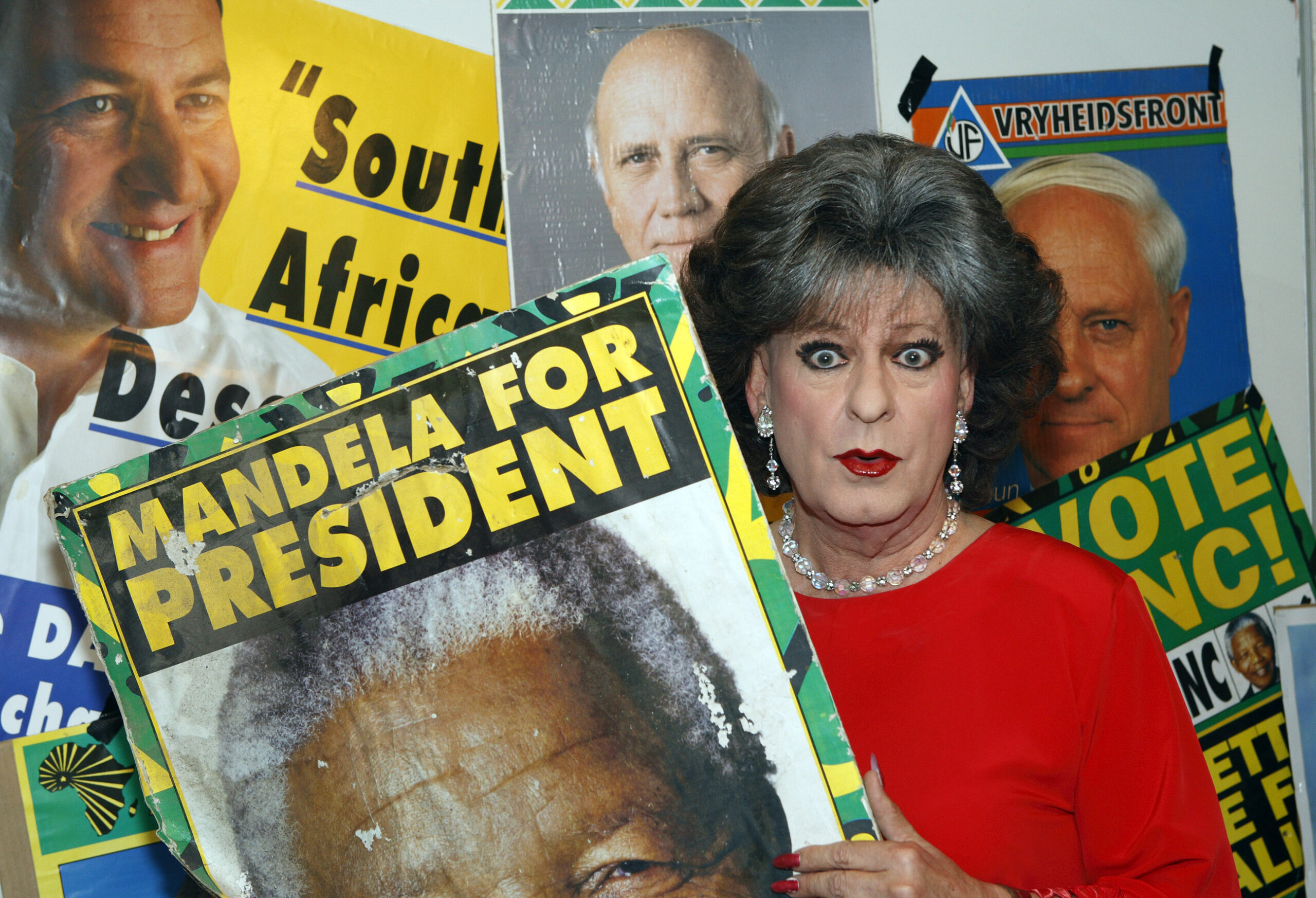
Pieter-Dirk Uys’s new show has nothing to do with Argentina or Andrew Lloyd Webber. It is, instead, a kind of launchpad for the political ambitions of this veteran South African satirist and activist’s grand yet gracious female alter ego, Evita Bezuidenhout.
The fictitious Ambassador to the Homeland of Bapetikosweti, Evita is South Africa’s answer to Dame Edna Everage and, as such, the most famous white woman in the country. She came to prominence some 30 years ago, since when her status as a national institution has been sealed by continuing media exposure (including a performance in the South African Parliament) and international accolades (such as the Living Legacy Award, an honour previously bestowed upon the likes of Mother Teresa).
But this is a solo, rather than a one-woman, performance. In fact, Evita doesn’t even make her glamorous and, frankly, anticlimactic entrance until the end of the evening. Before that Uys entertains us with a sharply scripted stand-up routine that plays like a crash course in postapartheid South African politics.
A deft quick-change artist and live caricaturist, Uys slips between characters of either gender simply by donning a jacket, scarf, moustache or wig. These range from Adriaan Vlok, the now-penitent former Minister of Police who claims that “apartheid was evil, like too much television” as he washes the feet of a ventriloquist’s dummy version of President Thabo Mbeki, to Mother Teresa herself, a celestial kvetch who rhetorically asks, “Does the saint wear Prada?”
Uys’s warm and cosy stage presence is offset by the impish gleam in his eye. Similarly, the tone of his show is mild on the surface, but flecked with barbed commentary and crafty throwaway lines. He has a particularly uncanny ability to get inside the mentality of a white supremacist. As a humorist who embraces the complexities and contradictions of Desmond Tutu’s Rainbow Nation, he can do no less.
Evita for President
– Lizzie Loveridge, Curtain Up, August 2007
I wish I could market some of the charm of Pieter-Dirk Uys, the South African comedian, campaigner for AIDS awareness and actor-creator of the formidable Mrs Eva Bezuidenhout, whose standing is such in South Africa that she meets, in character, with the top echelon of politicians. The magic lies in his gentle delivery, softly spoken, however direct his barbs. He pokes fun at anyone and everyone. He fell foul of the Apartheid regime and is not afraid to criticise their heirs when he finds them lacking, in the government of Thabo Mbeki. But his wit is placed with such a twinkle of good humour it never feels caustic or unpleasant or bitter.
His new show is entitled Evita for President and some of it is the supposed political campaign of his leading lady when Mbeki comes to the end of his second session as President of South Africa, unless of course as Pieter-Dirk wryly observes, he should change the law to allow a third term! He looks at South Africa before and after the 1994 establishment of the New South Africa. Writing in the programme, Pieter-Dirk says, “My South Africa is a thirteen year old teenager on the edge of adulthood with all the confusions, expectations, demands, fears and fantasies that entails.”
There are some lines or allusions which will only be understood by those who have a good knowledge of South Africa, but do not think that Evita for President is only for South African ex-patriates of whom there are quite a number in London. You may not get the exact context but there is plenty to laugh at and he has inserted some digs at the British and American politicians as well.
There are serious points to be made. In character, as a female Muslim shopkeeper, he bemoans the lack of employment prospects for the husband who “can’t get a job because he isn’t black enough.” (“He didn’t get a job under apartheid because he wasn’t white enough.”) He pillories the American government for imitating the Apartheid regime and locking up people without a trial, not on Robben Island where Mandela was imprisoned, but in Guantanamo Bay on Cuba. I loved the line when talking about a certain politician’s transplant operation he speculates that, ” . . . the liver might reject the body!”
Pieter-Dirk Uys ploughs much of the profits from this show into his theatre near Cape Town in a little place called Darling. He tells a wonderful story of a small African boy whose singing talent he encouraged and who, years later, came second in the Trinity College of Music exams for singing. As Evita, he tells us he wrote to the Adrian Vlok of the South African Secret Police under Apartheid, asking for them to lock up Pieter-Dirk Uys! He reminds us of how important humour is to human understanding.
Evita for President
– Jason Best, The Stage, 2 August 2007
Thirteen years after the birth of the new South Africa, the rainbow nation is “an extraordinary spectrum of confusion” quips satirist Pieter-Dirk Uys. Could Evita Bezuidenhout, “the most famous white woman in South Africa”, bring the country to order by standing for president?
This is the conceit of Uys’ latest one-man show, which delivers an irreverent yet compassionate survey of the current state of his native land. But before we get to meet his drag alter ego, an outrageous South Africa matron akin to Dame Edna Everage, we encounter a gallery of other figures, both real and imaginary, black and white, ranging from a shifty Afrikaner politician to a rich Jewish matriarch.
Slipping in and out of his various guises, Uys mocks President Thabo Mbeki’s endless globetrotting and his inadequate response to the country’s Aids crisis, and decries the ruling party’s corruption and cronyism (ANC stands for A Nice Cheque), but he also exposes the complacency of privileged whites and skewers the skin deep liberalism of old school Afrikaners who have trimmed their views to fit the new dispensation.
Uys balances his portrayal of present day South Africa with chilling reminders of the evils of apartheid, but occasionally the satire is blunted by the obscurity (for a UK audience, at least) of some of the figures he is lampooning. He conveys much more when he delivers the simple but telling personal anecdotes that show off his skills as a storyteller and give glimpses of hope for the rainbow nation’s future.
Evita for President
– Rivka Jacobson, The British Theatre Guide, August 2007
Thirteen years of democracy and memories of preceding years of Apartheid provide a fertile ground for stage performers. Pieter-Dirk Uys’ humour, dressed in satire, caricature and mimicry, exposes some of the social and political events and characters that preoccupy his beloved county.
He strides on stage, casually dressed in black, and, as if he is in the middle of a chat with old friends, says, “Two questions are asked round the table in South Africa.” With a charming smile and casual address, drops a cynical comment: “One must not be horrible about politicians. Where will we be without them? I know I will be speechless.” This is familiar territory for the audience and makes it feel reasonably comfortable.
The show is like an exotic salad prepared by the master and sole chef, the South African veteran comedian, Pieter-Dirk Uys. The characters impersonated, some more familiar than others, prove to have an additional flavour one may have not encountered before. It is all in the dressing. The mixing bowl is in a form of a formidable, yet fictitious white lady, with the name of Evita Bezuidenhout. Uys derisively informs us that she is so popular that even the world’s darling politician Nelson Mandela, invites HER.
The characters who are made the butt of Uys’ sarcasm and mockery are mainly past and present South African politicians garnished with Mother Teresa and suicide bombers up in Paradise. The Apartheid era politicians managed to escape trial for crimes against humanity and even masquerade as embracing the new democracy. The main protagonist of the new democracy is President Thabo Mbeki. A puppet in his image occupies a centre seat on stage. Mbeki’s love for foreign trips keeps him out of the country together with his cronies, who are branded as corrupt, leaving the country leaderless. Some politicians when traveling within Africa are said to do so via Paris, leaving the crime rate uncontrolled. HIV and Aids peppered with wanton ignorance, a declining economy and more. Despite it all we are reminded that even if some think that the country is going down the drain “at least it is our drain.”
The stage accommodates a row of chairs bearing the name “Mbeki” and different guises used by Uys to slip in and out the different characters. We finally meet the proposed candidate for December Presidency election. She is Dame Edna Everage’s South African twin, replacing the ostentatious spectacles with formidable eyelashes.
This show offers an entertaining evening for those interested in politics.