Archived Reviews of Desperate First Ladies
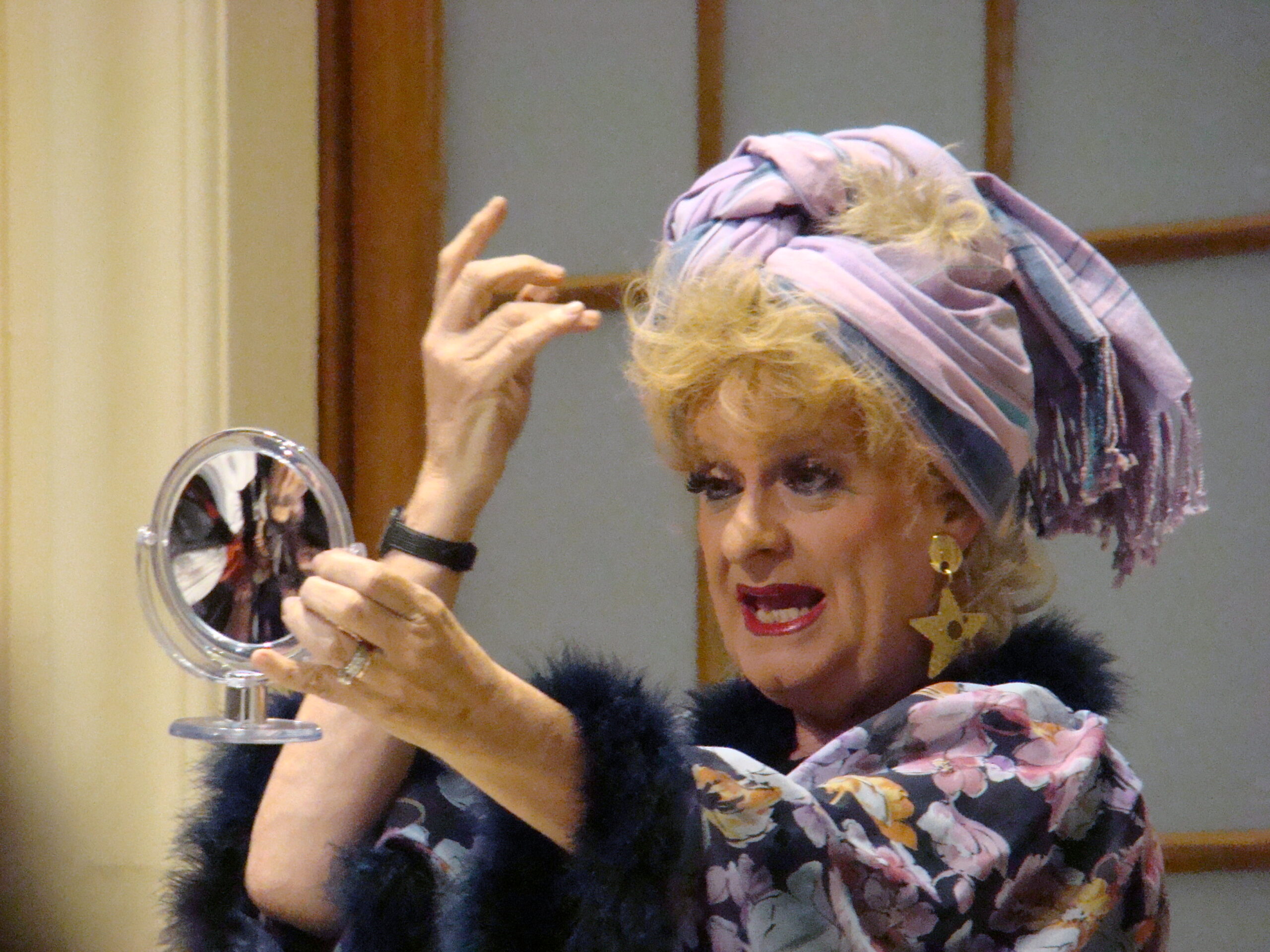
REVIEWS OF DESPERATE FIRST LADIES in JOHANNESBURG — AUGUST 2010
Mary Jordan: Review
– Mary Jordan, Business Day, 10 August 2010
PIETER-Dirk Uys is a theatrical phenomenon: successful, influential, an educator and a perfectionist. His conversation is witty and provocative, rather like Coleridge’s definition of Imagination: a combination of sameness with difference, of the unexpected and the familiar, of friendliness and competition.
Uys’s name is synonymous with surprise and even with shock, for he is a celebration of contradictions: hilarious and malign, polite and lewd, generous and caustic. But the most sensational of all his contradictions is that he has bamboozled us into accepting and keeping faith with Evita Bezuidenhout, the she who is a he, the amazingly actual star who has a complete life of her own.
Now, the joke of the pantomime dame lies in the tension between the female of the clothes and the sturdiness of the hairy male legs and heavy boots. The drag queen is the other extreme, really a man mocking a woman and at the same time trying to titillate the audience. Evita is somewhere in between: Uys, by the careful manipulation of Evita’s image on stage and screen, is a man, playing a woman, and making points about life. It is sublime character acting in which Evita takes on a visibility and a reality for audiences which vies with, and often subsumes, the public persona of Uys.
For Evita Bezuidenhout has her own inimitable style and career path. She has become a recognised celebrity, very much a part of the South African social scene. She has addressed Parliament. She has chatted to presidents and international movie stars. She is called upon to talk to book clubs, and to be interviewed on TV.
Yet, working from the premise that a politician whose intelligence is underestimated is more effective and more dangerous than a politician whose intelligence is respected, she never, ever misses an opportunity to hammer or lampoon those in government, for their conspicuously wasteful taste for the opulent and for their promises made and not kept.
What Uys has done, the trick that has been most successful, is to reproduce as accurately as possible something intrinsically funny in the way that most of us live. Once again he has repositioned himself, still illuminating the quirks and flaws in human behaviour , but registering and relishing them through the rich coherence of Evita’s own story, which Uys has built up over time, now barricading her into the trivia of domestic life by having her produce a cookbook.
Yet EVITA’S KOSSIE SIKELELA (Umuzi, R150), with design and culinary input by Linda Vicquery, is not just a random collection of soups and salads, bredies and curries, snacks, sweet desserts and tea cakes. It is a protocol of civility, an introduction to the difficult crosscurrents of modern family life, a rich description of ingredients and recipes that have remembered tastes and recollections, all heaped into a social archive to which each one of us can relate.
First, remove the dust jacket. Unfold it entirely, and there is Evita’s family, her son De Kock with his partner Moff de Bruyn, her daughter Billie Jean and husband Leroy Makoeloeli with their three children, LaToya-Ossewania, Winnie-Jean and Nelson-Ignatius. There’s a clock registering African time and a Groot Krokodil presented to Evita by the African National Congress Youth League. Glorious artwork on every page by Nina van der Westhuizen presents Evita in the styles of the Masters, from Rembrandt and Vermeer to Picasso, Warhol and Tretchikoff. Entertaining ideas range from Gorgeous Gay Muffins, Boesak’s Bubble and Squeak, Yengeni’s Swiss Chard with 4×4 Gravy to Golda Meir’s Chicken Soup. Each section is introduced with an irreverent rebuke, a resolute swagger, in the vigorous, confident falsetto prose that Evita has made her own.
Here are reliable recipes producing food that will not explode, collapse or fall over. Buy it.
Laugh, the beloved country
Evita Bezuidenhout and some Desperate First Ladies still pack an essential political punch
– Lesley Stones, Artslink, 8 August 2010
After 16 years of democracy comedian Pieter-Dirk Uys and his cast of characters should have been able to retire.
They should be an oddity, an anomaly showing of us how far we’re come since the days when the safest way to criticise was through cross-dressing comedy when the outrageous Evita Bezuidenhout could say what everyone else was thinking.
Thankfully the wigs and scarves, lipsticks and sequins are still shimmering, because nobody is going to swoop on Evita or Uys and bundle him into a police car for berating the new breed of politicians.
His new show Desperate First Ladies instantly proves Uys hasn’t lost his edge and we haven’t lost the need for him as he launches into an entertaining attack on efforts to curb the freedom of the press. It begins with Uys as himself, and it’s a pleasure to hear him give his own views in his own persona. He’s sharp and witty, and somehow more caustic and direct without the softening feminine accoutrements.
This is comedy not purely for the sake of being funny, but for the purpose of making a point through social and political satire. So while some of the sketches are less hilarious than others, they all pack a weighty punch.
Evita is hailed as South Africa’s most famous white woman, and nobody in power will risk making themselves look ridiculous by harassing this national icon. The show features a video of past and present politicians lauding Evita for the role she plays in fighting inequality and social injustice. Desmond Tutu blows her kisses, Mandela sings her praises.
Uys has crafted a unique and powerful position that he is still using wisely to be the conscience of the country without fear of repercussion. An undiplomatic diplomat who points out political and social ills, spreads the message about Aids awareness, and highlights the evil of men abusing women.
Uys has a deep dig at Zimbabwe too, singing a frighteningly feasible version of Old MacDonald’s Farm as he dons the jewels of Grace Mugabe.
Desperate First Ladies is having a short run to celebrate Women’s Day, and as part of it Evita welcomed SAA chairwoman Cheryl Carolus on stage for a brief interview. Together they make the point that women can stand up to corruption and force a change. Even in the interview Evita delivers barbed messages and social commentaries with humour. There’s a nice moment too when she hands Carolus a copy of her cookbook and urges her to send some overseas to those who have emigrated. “Tell them it’s time to come home,” she says.
One fabulous scene is where Uys recalls addressing an ANC conference and dressing up as Winnie Mandela, with a bracelet made of tyres and stompies and matches for earrings. Then the stomach-tightening horror as he notices Winnie in the front row. How — for once — he cuts his impression short and is later congratulated by her bodyguards for being brave enough to mimic Winnie. “We didn’t think you had the guts,” they say. “Do I get to keep them?” Uys asks.
It’s sad that South Africa still needs Evita — but it’s a very good job we still have her.