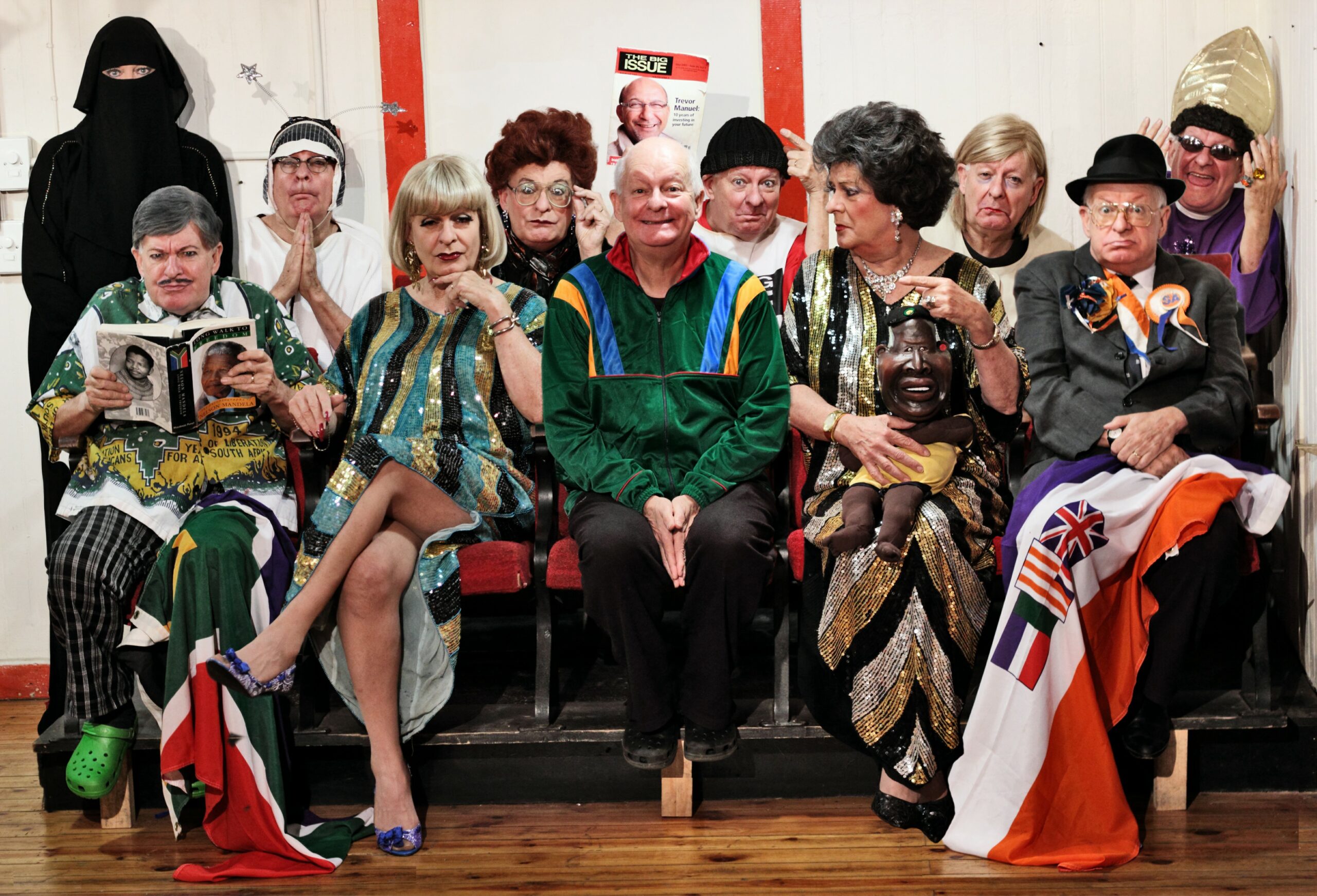
An Audience With Pieter-Dirk Eish!
Political satirist Pieter-Dirk Uys joins New24 host Jennifer Sanasie in studio to talk about his new season of theatre productions. The comedic activist shares his views on SONA and the importance of citizen’s being active and aware of parliamentary proceedings. From the shocking network jamming to the EFF’s interjections, Pieter-Dirk Uys chats about it all.
19 February 2015
Pieter-Dirk Uys’s show, An Audience With Pieter-Dirk Eish, is currently playing at The Theatre On The Bay in Cape Town until 14 March 2015.
A satirist and his cluster of creations
– Peter Tromp, 48 Hours, 19 February 2015
It’s been almost three years since we last spoke to PIETER-DIRK UYS (henceforth referred to as PDU), so it was about time to get the guy back in the paper for a bit of a chinwag. It helps that the celebrated performer, satirist and author turns 70 this year, and that he has a new show on the boards at Theatre On The Bay, ‘An Audience with Pieter-Dirk EISH!’, on until March 14.
The South African landscape of course is quite a bit different to how it was in 2012, so this is what PDU had to tell PETER TROMP.
How have you been?
Busy as always, enjoying the passing parade of icons and aikonas, red berets and giggling Zumas.
Tell us about ‘An Audience With Pieter-Dirk EISH’. What can audiences look forward to with the show?
The show is a tribute to audiences who make it possible to get onto a stage and entertain them. The focus is on LIVE — and so it reflects the emotion, the mood, the politics, the hopes and the hiccups of the moment. The show is also a unique structure: there are 20 boxes on stage each numbered, each with a sketch, a character and a story — and the audience chooses what number they want. So I am at the mercy of a democratic process, which means that the show is different every night as we cannot cover more than 7 out of 20 boxes per performance. The audience can look forward to a live performance of sketches old, new, borrowed and blue — and laugh at the very things they didn’t even want to think about.
Congratulations on turning 70 this year. How do you feel about this milestone?
It is just that: a milestone, not a millstone. I really couldn’t give a damn, but 70 is a good hook to hang product on, so this year will see one man shows, a new play, a musical, an anthology of dramas and an 80th birthday for Evita Bezuidenhout.
Somewhere in the press release it is mentioned that the show is a “celebration of South African humour”. Do you personally believe in such a thing as a national sense of humour and if so, what do you think ours reveals about ourselves?
There has always been a South African sense of humour. And let us thank the lucky stars for it. To have survived all those years of bad politics and still be embraced by the majority of our people who have no reasons to be nice, shows their sense of humour, dignity and compassion. There’s nothing as delightful as a poep-grap in Afrikaans. There is also nothing as refreshing as a good laugh at the expense of arrogant, lazy, corrupt politicians — so my show is one big laugh after the next.
Which of the characters you have created over the years would you say you relate to the most?
Like all loving parents I relate to each one with respect and commitment. They have to be real otherwise why would an audience bother to leave ‘Game of Thrones’ for me? Evita is of course my head girl and PW the retired chief whip — but Mrs Petersen from Manenburg is a favourite, Bambi Kellermann waves her condoms and I have a cluster of new characters in ‘EISH’ that I think will be embraced and enjoyed.
Random question: what is your favourite caffeinated beverage?
Glad you spell that word with a C and not a K! I haven’t had chocolate for nine years as I am a chocoholic. I stopped coffee because of reflux and what can I say? Enjoy it while you can!
What’s special about performing at Theatre On The Bay?
I feel safe and loved by my theatre family there, because I know so many of the people who have grown up in theatre with me. Pieter Toerien like me also comes from Pinelands. And the drive over the Nek down into Camps Bay at sunset every night is such a gift.
Your latest show comes at a particularly turbulent time in SA. What advice do you have for folks who are trying to remain positive during these trying times?
In Afrikaans I would say, “Moenie panic nie; alles sal regkom.” Democracy will always have speed wobbles, but at least we still have our freedom of expression. Come to the show and celebrate that. It’s a bit like the old radio show Pick a Box — but as the show reflects much of today, call it Kies ‘n Doos.
Another random question: which book(s)/movie(s) can you read/watch over and over again?
Give me a Bette Davis any day. I love great, creaky, over-technicoloured musicals. (I watch) ‘Lawrence of Arabia’ at least once a month. And my beautiful Sophia Loren. Books: autobiographies. Collected letters. All lies, but usually so compelling. And I read eight magazines per week and six newspapers per day. That’s homework.
Yet another random question: Do you sing in the shower and if so, what’s your go-to tune?
No singing in the shower. I sing softly in my bed when I wake up at 3am and because there is load-shedding I can’t watch an episode of ‘Maud’ or ‘Faulty Towers’. So I sing there. Very softly so as not to wake the cats.
Finally, what else do you having going on at the moment, and what can we expect from you next?
A show called ‘Nkandlakosweti’ with Evita and her secretary from 12 years ago, Bokkie Bam. Yes, Lizz Meiring is back with me. That’s in September. Meanwhile, check out www.evita.co.za for news and which shows are on at Evita se Perron in Darling.
* Performances will take place from Mondays to Saturdays, at 8pm; and Saturdays, March 7 and 14, at 5.30pm and 8pm. Book at Computicket.
‘An Audience with Pieter-Dirk EISH’
– 48 Hours, 5 February 2015
Some people have called it a red carpet parade of icons and aikonas. Some have said it was a history lesson combined with an episode of ‘Idols’. And an elderly kugel again nasally complained that she didn’t know why Uys still did his character of Nowell Fine, “because I don’t know anyone who talks like that. I swear to God.”
‘An Audience with Pieter-Dirk EISH!’ will usher in the Cape Town-born playwright, satirist, actorvist and, in this case, stage-manager’s 70th year. He’s been doing this ‘thing’ for so long, some people even call it a career. And for the first time his focus is not just on the glitter and glamour of the stage, but the laughter and excitement of the audience. Members of every night’s celebration of South African humour will have a chance to choose a numbered box. PDU will then share the character, the story and the uniqueness of this presentation which will be different at every performance.
On the red carpet of fame and infamy Theatre on the Bay will host familiar legendary Uys characters like Tannie Evita Bezuidenhout, Nowell Fine, bergies and Bothas. A white racist voter from 1985 morphs into a white conservative voter in 2015, still thinking the same politically-incorrect thoughts, but grateful for the job his BEE bosses have given him. ‘Cyril for President’ is what the Big Issue vendor suggests, while an tired member of the Cape Minstrels shares a bitter-sweet ode to the Mother City. Mrs Petersen from the Cape Flats, already beloved by many in the Cape, is having to fill in the complicated UK tourist visa form to go and see her family in Manchester, while Nelson’s warder at the old Vic Verster Prison waits for buses of tourists to arrive as the Robben Island boats are still broken. A sinister Grace Mugabe shares her ambitions to be Zimbabwe’s Numgber One in song, while Winnie, the mother of the nation, demands an audition before she allows a white satirist to make fun of a black majority. Evita’s sister Bambi Kellermann isn’t shy about talking more than birds and bees, and Madiba recalls the once-revered total transparency of ANC policy.
While Uys was heavily censored during the apartheid era, he ironically refers to the Publications Control Board as his PR Department who corrected the way he misspelt certain Afrikaans four letter words.
President Zuma showers everyone with smiles and good stories that few will believe, while some memorable reminders of what horrors the past got away with, will make one wonder if history is in fact repeating itself in South Africa behind our backs.
‘An Audience with Pieter-Dirk EISH’ is a unique way to remember where we come from and to celebrate where we are going. There will be twenty boxes to choose from, so a few visits to the Theatre on the Bay between Wednesday, February 18 and Saturday, March 14, might allow you a grand slam of Uys’s complete satirical cluster.
Performances will take place from Mondays to Saturdays, at 8pm; and Saturdays, March 7 and 14, at 5.30pm and 8pm.
Bookings are open at Computicket.
Pieter-Dirk Uys brings his charm and wit to the Auto & General Theatre on the Square with his newest production, Pieter Dirk-Eish!
– Heather Djunga, Sandton Chronicle, 16 May 2013
PIETER-DIRK Uys dons many hats for his production, An Audience with Pieter-Dirk Eish!, at the Auto & General Theatre on the Square, running until 25 May.
Uys is perhaps best known for his character Evita Bezuidenhout, who first graced South Africa’s stages some 30 years ago. In an exclusive interview with the Sandton Chronicle, he explained the much-loved Evita had to share the stage with some 15 other characters in the show — something the diva was ‘getting used to’.
The show is a mosaic of different skits performed by the various characters Uys has perfected during his many years on stage. These characters emerge out of boxes on stage, joining the show as the audience members get to choose which box they want him to open next. Because only a few characters can be in a single show, each show is different.
Uys doesn’t just star as the buxom 16-character cast. He is stage manager, lighting specialist, scriptwriter and “I do everything,” he said. There had been challenges in putting the show together. “Evita had to go on a special diet. She has to look good for her audiences, you know.”
Uys said in his 40 year career, 80 characters had come to life through him. “There are also famous politicians in the boxes,” he said. “Yes,” he laughed, “Malema is also in there.”
Through the characters, Uys pokes fun at the status quo of the country. “I make bold statements through humour,” he said. “I challenge people to laugh off their differences.”
“Evita had to go on a special diet. She has to look good for her audiences, you know.”
He said since he first poked fun at politics, South African audiences were more liberal in laughing at things. “We have learned not to be afraid to laugh at the government and they have even learned to laugh a little at themselves.”
Have any politicians watched his show? “Maybe some have… undercover.”
“I consider my characters watchdogs of the powers that be, if you will. As a watchdog, Evita is a little chihuahua. She says serious things in a very precious package.”
Uys said he came from a family of performers. Mom and dad were classical pianists. “My sister Tessa in the UK also plays the piano and we make quite a team onstage. Evita unfortunately cannot sing, but her sister, also one of my characters, sings beautifully.”
Next on his agenda, Uys will be launching a new book, Panorama to coincide with the 20th year of South Africa’s democracy.
Does he consider himself political? “No, politics is the spice of life. It isn’t an institution, but is in us and is everywhere. Being South African is the greatest experience. We have the most diverse, interesting, irritating characters to draw inspiration from and to make our lives rich and colourful,” he said.
THE BIG INTERVIEW: Ticking the right boxes
There are 16 boxes on stage, each containing a secret stash of costumes and props. By picking and choosing which box Pieter-Dirk Uys unpacks the audience has the power to decide the narrative outcome of his new show.
– Jackie May, Times Live, 3 May 2013
In An Audience with Pieter-Dirk Eish, Uys knows what the boxes contain but he has no idea what sequence of choices audiences will make.
“It’s the most interesting fun I’ve ever had on stage,” he says. “You make the show. You decide.”
With this work, Uys makes a transition from presenting “a narrative of punchlines” to giving the audience the responsibility to decide on the story. As with the responsibilities that come with democracy, he is giving his audience the freedom to decide on the outcome of their entertainment.
At 67 he is still as passionate about our political life as he has always been.
“This is our country. You have to know what went wrong, because those things can come back. Freedom is earned,” he says admitting to worrying about South African apathy.
“Freedom cannot be taken for granted.”
By making people think, talk and laugh, uncomfortable truths are constructed and deconstructed. The boxes can be seen as a metaphor for the building blocks of democracy. By rearranging and unpacking them there is “mass destruction” preventing the rot from setting in permanently.
“People are always surprised that they laugh at things that frighten them. They laugh at things they don’t want to think about. Violence, disease, rape – these aren’t funny. But fear, prejudice and hypocrisy – look at them closely and you’ll laugh. If we don’t address these issues, they will grow.” With each box, Uys changes character, make-up and clothes. Personalities include his alter-ego Evita Bezuidenhout, Nelson Mandela, Margaret Thatcher and maybe even PW Botha.
His audiences, Uys says, are multi-generational. People of “my generation remember the past. Many are awkward about race. But then there are the under-25s, who sometimes don’t know what the f**k I’m talking about.
“I tell them to keep their phones on. Verwoerd? They must Google what they don’t know.”
Comparing his early work to today’s, Uys says that for years it was obvious what the targets were. “There was one target and it was wrong. Boom. And there was an alternative.”
He says he is grateful that we didn’t have a Syria season.
“But the kids are pissed off. They were born after Mandela was freed and they have had a kak education. They don’t have the money to go to university, and no facilities to get jobs. They are not stupid.”
The Arab Spring could still come to South Africa, he warns, but while we have a democracy we must know whose fingers are in the pie, and know what the pie is.
“[Jacob] Zuma is going to be here for a long time – not as long as it will take to get an Australian visa – so read up about him. Find out about the man who is looking after your pension and your children’s education.”
Talking about the Zumification of South Africa, Uys says on the one hand: “I am delighted to see a South African president and not a copy of a British president like Thabo Mbeki was.
“I like Zuma’s skins, his singing, but don’t underestimate him. He is very astute and very clever. He is like a chameleon.”
Uys says Zuma watched quietly as Julius Malema performed political theatre and did nothing, but, “suddenly out comes his tongue.”
But the 67-year-old satirist and performer, who has lost none of his enthusiasm and active interest in politics, says the secrecy bill will change everything again.
“If it is passed, I will guarantee the audience that every one of my boxes has a secret. What are the police going to do? Come every night? I am not going to keep quiet. N.O. No.”
An Audience with Pieter-Dirk Eish opens on Tuesday and runs until May 25 at the Theatre on the Square, Sandton.
PIETER-DIRK’S OTHER LIFE
I’m listening to — an iPod with more music on it than I have ever collected or collectively listened to in my life.
Reading — Hilary Mantel’s massive paperback Wolf Hall, which doesn’t allow you to skip a word or a paragraph.
Eating at — La Perla restaurant, Beach Road, Sea Point, which is my stomach’s favourite retro experience. Been happy there since the 1960s.
Drinking — in the garden of the Mount Nelson Hotel in Cape Town with a perfectly etched Table Mountain against the bluest sky. Was it all filmed against green in a studio and then photo-shopped?
Watching — an albino squirrel preen and behave like a movie star on a branch before he leaps down and steals a nut out of the bowl next to the glass of chardonnay.
The funniest thing I’ve heard — is the mindless optimism about the Protection of State Information Act which kicks us back into the Broederbond dark ages.
Uys is cooking up something new
– Diane de Beer, Tonight, 30 April 2013
ONCE, while trying to leave a phone message, Pieter-Dirk Uys had trouble getting his surname across.
“Yes, it is Pieter-Dirk Eish,” was the eventual compromise. And that, partly, is where the name of his latest show comes from.
An Audience with Pieter-Dirk Eish! engages audience members directly in that they decide which character he’ll animate next.
Around the late 1970s he was experimenting with a character based on a fictional cabinet minister’s wife — someone whose voice he could use in his Sunday Express column. An editor read him a mini riot act about this “Evita character”, who was saying things regular journalists couldn’t.
Uys realised the editor was referencing Evita Peron (since the musical had just come out). But it was only in 1981, when a journalist pressed him for a surname for the newly created stage character, that he decided definitively on “Evita Bezuidenhout” (for which actress Aletta Bezuidenhout has never forgiven him, because he got the idea from her name on a poster for the play The Seagull).
The 67-year-old actor, playwright and satirist told the story at the launch of Evita’s Bossie Sikilela at Kelvin Grove in Cape Town.
You won’t normally see Uys appear on the same bill as Tannie Evita, but he figured that since he was not a cook by any stretch of the imagination, he had to explain how the former ambassador to Bapetikosweti came to be in the cookbook business.
Uys sees the cookbook as a way to bring the message of reconciliation through Tannie Evita, because if he tried saying what she said, he would just sound preachy.
Also, he gets the giggles when he tries to tell other people what to do.
“I’ve watched other people stand up (and ‘preach’) — Bono and Bob Geldof, performers, Angelina Jolie and all of them. My first reaction is: ‘Shut up and sing and act.’
“I’m not an activist. I’m an actorvist. I just feel that the framework of entertainment is so much stronger to put across a message of import to an audience, rather than give them a lecture or a moral finger-wag.”
So, instead, Uys is the stage manager organising everything behind the scenes “so that Tannie can walk out of here and I must just keep my tummy in”.
“It’s a great thrill for me to stop in my tracks and think: ‘My God, for 30 years a woman has been in people’s lives, and she doesn’t exist.’ But she is not sitting on my shoulder and she is not in the back of my car — as a woman. She is in the box in the boot.”
As interesting as he finds the phenomenon of created characters living in the consciousness of the public, the actorvist in Uys cannot help but want to bring people back down to earth, to point out what is happening right under their noses.
“Not many people know what Nkandla is,” says Uys, referring to his book-launch audience. “They don’t read the papers.
“That is the great pity. I always say the legacy of apartheid among white South Africans is a terrible fear of opinion. They are scared of having an opinion in case it’s wrong.”
He did one performance of An Audience with Pieter-Dirk Eish! in Grahamstown earlier this year at the invitation of National Arts Festival director Ismail Mohamed, who asked Uys to do something he’d never done before.
“I’ve not had a baby on stage, but I’ll try,” he remembers thinking.
During the performance he has 15 boxes on stage and audience members pick a box (though he calls it “pick ’n doos”).
Uys then transforms himself into one of 15 characters he’s played over the years, ranging from Piet Koornhof to Bambi Kellerman, or some new ones he’s been working on in his home town of Darling, depending on what costume is in the unmarked crate.
“I have 15 stories to tell and all of the stories are anchored in where we are today.”
The stories are constantly morphing, depending on what’s in the news. Uys is a total newshound, who reads the newspapers every day and trawls the Internet for news snippets. Instead of the usual announcement to switch off your cellphone, he encourages audience members to leave their phones on silent, “so you can google what the hell is going on”.
“Quite frankly, it’ll be a different show each night.”
Uys’ Evita character goes back 30 years and he’s a great one for recycling costumes and referencing his work.
But he is also a keen observer of humanity and trends in the contemporary arts.
“Last year three of the most successful plays (referring to Somewhere on the Border, Woza Albert! and Statements After an Arrest Under the Immorality Act) were plays that were nearly 40 years old.
“The extraordinary thing about Statements and the other Fugard plays — and hopefully my old plays as well — is they’re not seen as political statements, they’re seen as people trying to communicate.
“That’s what I really want to focus on. The show, this one — my priority there is it’s about people, it’s not about politics. It’s not a political statement. It’s just to get you to reflect on the humanity of what people have gone through.
“I call myself the Ha-Ha History Channel, because there’s nobody here in my business who has been around for 40 years, who can say: ‘I was here when that happened.’
“Why’s it happening again?”
• An Audience with Pieter-Dirk Eish!, the Theatre on the Square in Sandton, Monday to May 25.
Pieter-Dirk Uys: Eish! Still a Struggle
– J Brooks Spector, Daily Maverick, 26 April 2013
We meet in a sunny, bustling eatery in the near-in suburbs. Pieter-Dirk Uys is back in Johannesburg again, preparing for performances in May at the Theatre on the Square. The man has already been an institution for 40 years and somehow his humour, his energy and his moral outrage never seem to flag. Today is no exception.
Speaking about his upcoming show, this time around, it seems a kind of theatrical interpretation of Heisenberg’s uncertainty principle — if the audience touches it, it changes. He explains that, traditionally, in his shows, he starts out wearing a jacket and trousers and ends up in a dress — a sly, sideways nod of recognition for one of his most enduring and best-loved stage characters — Evita Bezuidenhout. Evita is his alter ego, the former Ambassatrix to Bopetikosweti, who has, through all these years, spoken those uncomfortable, awkward truths to power in the most politically incorrect possible way.
But this time, Uys explains, the show is different. In was in an earlier version at the Grahamstown National Arts Festival last year, then it was performed in Cape Town, and now, finally, it is about to go on stage in Johannesburg. It is a risky project. Stacked on stage are 16 boxes. Each contains a different set of costumes and props while the accompanying stories and routines are locked away in Uys’s own fertile mind. As he describes the arrangement, he has three-and-a-half hours of show material potentially available on stage. But, it is up to the audience to decide which ones are picked and that he will perform — and in what order. Beyond picking the material, the audience is making Uys’s choices for him — and thus influencing how the show’s different elements will actually relate to each other for the 90 minutes he will perform each night. And each night will be different, depending on what the audience selects.
Then he explains how the name for this show came about. He was speaking on the telephone with someone at a theatre in Pretoria and he was having increasing difficulty getting his interlocutor to understand who was calling. The conversation began, “Hello, this is Pieter… P-I-E-T-E-R; Dirk… D-I-R-K; Uys…” “Eh? Who?” “Uys, U-Y-S…” And then from the other side slowly came: “Eish!” This simple bit of word play is truly funny when he tells it, but it is almost impossible to capture this precise delivery in print. It is a strange mix of crisp, lightly Afrikaans-accented English, a dash of RP, and more than a hint of an arched eyebrow and an eye rolled heavenward. To truly appreciate much of what Uys actually does with his voice and then render it in print would require a lexicon of diacritical marks for all of his many inflections, sustained phonemes and subtle pauses. Even Victor Borge’s audible phonetic punctuation wouldn’t be much help here.
We talk about how he achieves his characterisations. He explains that the face is important. When he does (or did) Margaret Thatcher, he sought what he called the lavatory face with its accompanying, extended vowels, a kind of “Ouuuwwwh!” Actually, he says, he prefers not to do actual current politicians. “I don’t want to come across as a second-hand Leon Schuster, he does that much better,” he says. Rather he likes to set out a more protean character, but one locked in a politically charged situation set up by the politicians. Having said that, he must surely realise, too, that his legions of fans still live for just one more repetition of PW Botha and his finger wag — even if the old “Groot Krokodil” has long since vanished from the political scene.
Uys adds that for him, doing current politicians means that “The red line of racism is close to the toe of my shoe. I have to be very careful not to cross that line.” And doing some scenes — and some people — as points of ridicule may well provoke the precisely wrong reaction on the part of people who have come to the theatre for the first time in their lives for his show.
The word “kaffir”, he says, is a particularly difficult word to deal with successfully — is a very fraught word for him. Yes, it fitted into a much older sketch with origins back in 1984 that portrayed an angry racist kicking and excoriating a black man on his bicycle. Now it has been updated, but the kicker in 2013 is that the racist has become the gardener for a black professional woman, a university professor. But the backdrop for the sketch is now more complicated. “I just don’t use that word in that sketch.” Pausing for a moment, Uys adds a verbal footnote. On the other hand, a word like that should be used so often that its power to hurt is drained right out of it. As a comic, a satirist and deliberate mirror to his society, the meaning and power of words remains central to his work and he wants to draw upon that power as a weapon against such words.
Speaking of symbols, he speaks about the DA’s appropriation of that still-politically potent old South African flag, with its orange, white and blue horizontal stripes, now married to the current ANC emblem as a weapon against the majority party by the DA. Uys is theatrically angry about this usage. Not solely because of what it means or says, but rather because he adds, “They’re using my material! We’ve really got to deflate that…. It plays into the racism of the other side…. Excuse me. I have had that in my show for several years already! I have just written a letter for the newspapers…. They either have to acknowledge it and pay me royalties – or stop using it.” Is he serious about this, or is it a clever way to take the sting out of yet one more artefact of the rough and tumble of politics? Or perhaps both?
On the other hand, he worries that “Racism is back and it is in the hands of the party I fought for and I am very upset about this…. Of course at least we have freedom of expression, but the day we are compromised we are in trouble…. The day he signs that [the secrecy bill] into law and I criticise the government, I have revealed a state secret.” That, in turn, provokes a recollection of the Apartheid-era Publications Control Board, Uys giggles for just a moment and says, “Ah yes, my old PR department…. But the thing I do worry about now in our democracy is self-censorship…. And I am coming across it everywhere.”
We turn to the decline in the quality of education in the country. Uys has been a strong advocate of high-quality schooling (and honest and thorough sex education) for years. But he says, now, “I’ve stopped being exasperated, it’s too exhausting…. But I still go to schools with my programmes, but it is no longer just about HIV/Aids.” He tells pupils, that yes, “Sex is nice, but it is like swimming in a sea full of sharks. Now let me tell you about the sharks…” He then remembers, that when he was at a school six months ago, he was speaking to the Grade 12 pupils, men really, and “they tell me, I don’t use a condom, I take a shower” — it’s that still-lingering echo of an infamous presidential statement and an excuse. “I laugh but the students are no longer so friendly as before.”
He shuffles around with some papers that have been sitting in front of him all this time and he says, “I have a novel — coming out next month, I’m very excited about it.” The book jacket blurb begins, “Panorama — Robben Island — right on the edge of the world like a full stop at the end of a long sentence called Africa” and the book begins in 1987.
Is he ever fearful he has been overtaken by events? He replies that he tries hard to imagine the worst possible things and then he is never surprised by anything because he has already imagined much, much worse than what actually is happening.
Is it time for some of Uys’s older characters to be retired? “Oh no, Evita has lots of time to go still before the retirement home, she’s gone to Luthuli House instead, which is almost the same thing.” We reminisce about his introduction of the Jacob Zuma puppet with the trademark showerhead during the previous national election. Uys explains that he now has a new puppet, a Julius Malema doll — the little child who was crying in an alley whom Evita has adopted. Uys warns not to write Julius Malema off just yet — because there is something there still. There is more about Malema in a few minutes.
As far as new characters and situations go, Uys says some characters have been with him for decades — and audiences have come to know them and watch how they have changed and evolved. And as far as the Mandela family’s troubles? Well, he has added a Mandela granddaughter. “Free Mandela from his family!” he says. And of Winnie? “She’s okay as long as she takes her medication…. And my new project for the election next year will be, ‘Nkandla – Don’t cry for me Nkandlakosweti!’”
Turning to the country’s actual political future, Uys says, “I see an Arab Spring.” He argues that if he were a young South African who votes for the first time next year, given the poor quality of their education and governance, he scowls and says, “I would take a stone…. I can’t tell you how perplexed I am by the generosity and patience of this generation so far. But do not underestimate their anger…. They really and truly want their dreams to come true. They are not interested in what their parents went through…. And that’s why I miss Malema because his voice was important to listen to from that side of the ANC. That fact that he did it wrong is not relevant, he focused on things that needed to be focused on.”
Even so, if we have a good election we’ll be fine for the next 10 years, he adds. Good? Good equals a strong turnout, a good of balance of choice, little racism in the campaigning and the DA focusing on all the areas of society that did fight Apartheid, not falling back on things like that snide use of the old flag. “That’s my job — not theirs!”
So who is leading by example right now? Uys says that Trevor Manuel is one (until he trips over his own halo), Lindiwe Sisulu is one, the minister of health is another, and Graca Machel is a great Southern African. He pauses at Mamphela Ramphele. He says that he just hopes she is doing a huge amount of work to build credibility with the people who matter. As for the larger shape of the country’s future politics, Uys says he actually hopes for a split in the ANC — that would help the country’s democracy mature, along with an alliance of the opposition parties.
The conversation turns to Jacob Zuma. Surely it must be hard to imitate him? We agree the best thing might just be to have a large stone on stage sitting on a chair – he, it, never says anything. Then he adds, “Of course I always like to think of him like a chameleon, with those eyes.” And as for the new fad of blaming everything on Apartheid? As one of Uys’ other characters, Bambi Kellerman, says, “That’s like blaming the mini skirt on Adolph Hitler!” But even after having said that, Uys adds a footnote that of course it is true with middle aged people and above that the emotional legacy of Apartheid lingers into the present. For example, he explains how at his Boerassic Park venue in Darling, there are some of those old racial segregation signs – Whites Only/Blacks Only – and the older generation continues to be flummoxed by them when they encounter them at the venue’s various doorways.
Thinking further about the country’s political shape, Uys adds with characteristic bluntness, “There was a moment when I thought the Malema-factor would split the party at Mangaung, but Zuma was brilliant… and he’s doing it the African way, he’s creating his own tribal homeland…. And if you cross him? Malema was bankrupted in a month. The rest of the Cabinet should have been bankrupted in four years and they’re still in their jobs. The majority of the voters are poor. They will be poorer still by the time of the election. If Malema formed his own party and called it the ‘real ANC’, he could be elected.” It could happen, he insists.
Are there things he won’t touch in his performances? “There are things I should do like religion. I’m courting the area but it is not what is dangerous for me, I don’t want to lose the audience. But there are ways of doing it.”
Then he tells a wonderful story about his father who was actually on the Apartheid-era’s censor board. Uys says that after a few weeks of doing this work, the elder Uys met up with his son and told him to make fun of the censors because they were idiots, they didn’t know what they’re doing, they were destroying the films they dealt with.
But then he offered still more advice. His father had been dismayed by some of the language Pieter-Dirk had been using on stage and so he told his son that he didn’t have to use all those words. Instead, he said, “Don’t put your finger in my eye, tickle me behind my ear and eventually my eye will find your finger.” Being on stage you have tremendous power, Uys explains.
Finally, returning to current politics, what about the DA’s efforts to expand its political heritage back 200 years and simultaneously airbrush out some of its history? Of all the unexpected comments, Uys proffers ex-party leader Tony Leon’s advice not to fight this coming election on the basis of the past. As far as the DA’s sudden embrace of Nelson Mandela, Uys says that of course he too embraces Mandela, “we all embrace Mandela”. But this must mean that Uys believes this is simply not enough to win the hearts of the born-frees.
As we wind up lunch, he notes he once learned that Madiba, when he was president, had on his desk a framed picture of the president embracing Evita in full costume. Now that’s something we’ll bet most readers didn’t know before reading this article.
Pieter-Dirk Uys is at the Theatre on the Square in Sandton from 6-25 May.
Read more:
● Pieter-Dirk Uys, the man’s own website (contains comprehensive links to recent reviews of shows and other materials)
And for a look back, try two stories from around 10 years ago:
● Satirist of Apartheid Finds New Target at the New York Times
● Piano Returns To Berlin, Releasing Family Secret at the New York Times (about his family history, a family piano and his sister’s musical career)