Archived Reviews of Bambi in Kabaret
REVIEWS OF BAMBI IN KABARET IN CAPE TOWN — MAY and SEPTEMBER 2006
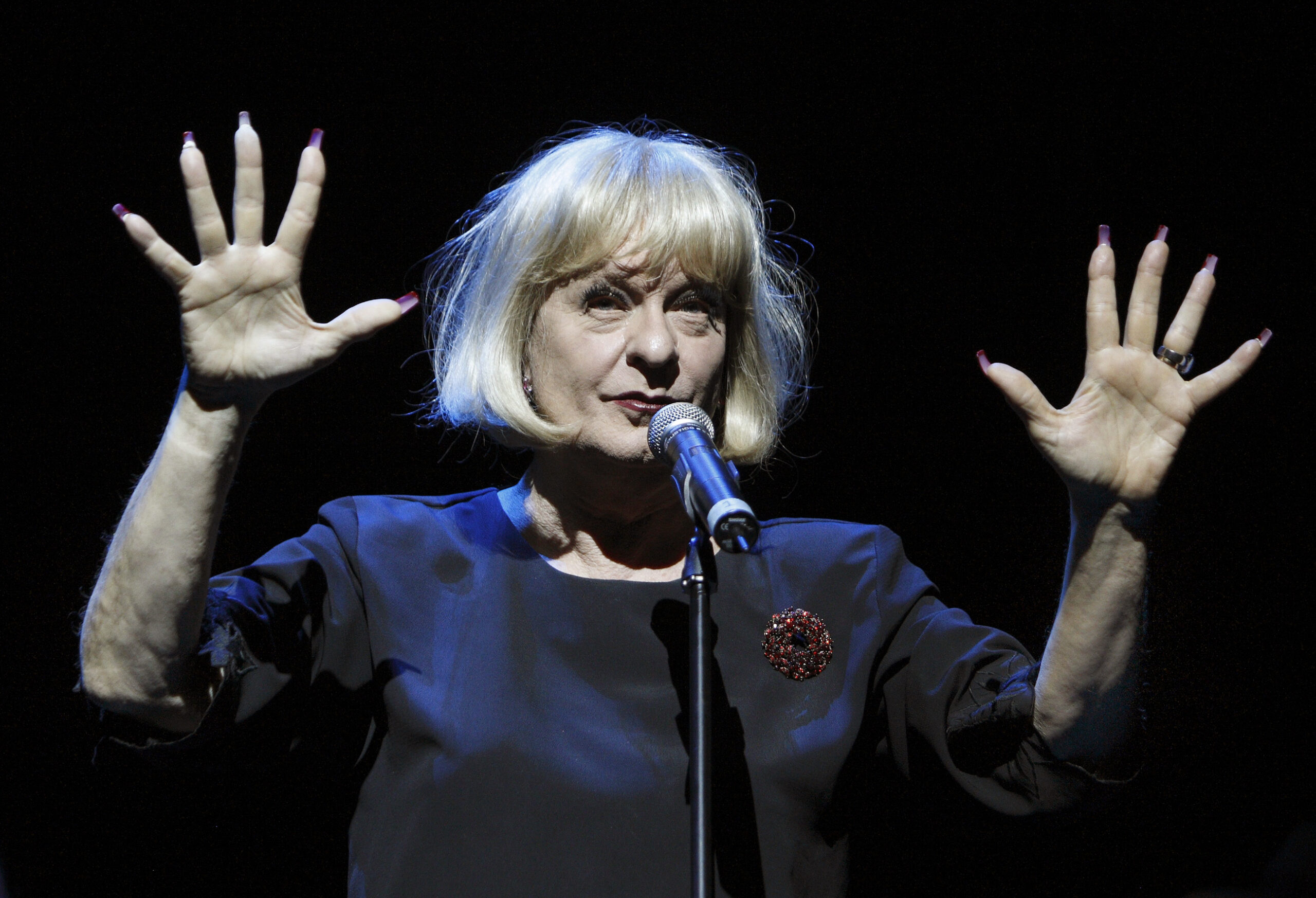
Bambi In Kabaret
– Peter Tromp, IOL News, 8 September 2006
As Pieter-DirkUys put his social agenda on the frontline over the last couple of years, it has become relatively easy to feel that one has gotten him only in little bursts.
We missed seeing him on stage — the place most of us still consider his home — as he criticised the government’s Aids policy here, and taught people about safe sex there.
But with Bambi In Kabaret, Uys is right back where we love him — where he is able to marry his soapbox with his brand of pure satire.
This is entertainment of the most uninhibited and highest calibre. If it is his intention to dazzle, then Uys succeeds marvellously, reminding us that he is a performer and entertainer of world class.
Bambi Kellermann (born Baby Poggenpoel) is the younger sister of Mrs Evita Bezuidenhout, the self-styled “most famous white woman in South Africa”.
Whereas Evita has tread the straight and narrow route of politically correct integration and has become a household name and favourite across political-party lines, Bambi has smouldered in the background.
She’s not as famous as her sister because her vitriolic inhibition makes her a tad more uncomfortable to live with, and she is the kind of girl that will speak the truth, as bluntly as possible if there’s a choice.
To crown it all, her life’s trajectory has taken her down all manner of side-alleys, including stints as a prostitute, being diagnosed with Aids and, perhaps primarily of all, being married to a Nazi. It is perhaps understandable that Evita, being perhaps more conservative in her tastes, has kept her distance from her “colourful” sister.
Like the best kind of popular entertainments (television shows like The Simpsons and Buffy The Vampire Slayer spring to mind) Uys has over the years created a rich mythology of complex interlaced characters. He has also mixed fictitious history with the real deal and created a truly hearty broth that never fails to fulfil.
As the title suggests, this is a cabaret, and the little colourful-world-unto-itself that this form of art often delivers better than any other kind, is wholly present here.
With Uys’s wit and campy charm enveloping one like a warm blanket and Godfrey Johnson’s crackpot piano playing setting the score, it felt at times as if I was losing myself in the little universe that is the Intimate Theatre.
With classic singing, political observations subtly integrated into the natural text and true showmanship, this show is surely the most hypnotic cocktail around.
Bambi Kellermann — In Kabaret
Featuring Pieter-Dirk Uys and Godfrey Johnson. At The Intimate Theatre every Sunday until June 10
– IOL News, 11 May 2006
Bambi Kellermann is the younger, more attractive (at least she believes she is) sister of Evita Bezuidenhout. But their relationship is so messed up the two are never seen together in the same venue.
This is the premise from which Pieter-Dirk Uys works as he introduces Ms Kellermann who bears a striking resemblance to that German songbird Marlene Dietrich.
Uys pays homage to her in a section of the show.
The Intimate Theatre is transformed into a space of merriment and sophistication when Bambi enters dressed in a very elegant black two-piece with black-and-white overcoat.
But it is the cleverness and expert talent of this stalwart performer and theatremaker that makes this show such a hit. That and Godfrey Johnson who did the musical arrangements and who accompanies Ms Kellermann at the piano.
Johnson has a quirkiness of his own that complements Uys’s to a T and together they sing while Kellermann tells of years gone by.
Even her accent is spot-on — not too heavily German but maintaining enough of her Afrikaansness (sic) to tell her humorous stories multilingually. The predominant language is English with Afrikaans, and of course, German – a language she has assimilated well.
Her tales, however funny, are not without their serious messages. Her songs, even, however mimicking, are not without their significant contributions to the political milieu as she knows and understands it.
This is the perspicacity that is Pieter-Dirk Uys. He uses his characters well to speak of the evils of our time — HIV/Aids, apartheid and loss of humanity are all contained in the yarns he so persuasively spins.
And we know this is but a fictitious character who was born in the imagination of a person. But Uys is able to induce any audience into believing in him, his characters and what they have to say. This is the mark of a true satirist.
Piercing satire, melodic music and just a hint of chic profanity (oxymoron intended) lies at the heart of this slick production.