Archived Reviews of An Audience with Pieter-Dirk Eish!
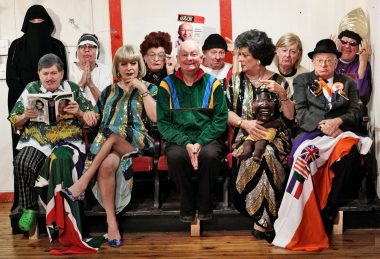
REVIEWS OF AN AUDIENCE WITH PIETER-DIRK UYS in LONDON — JULY 2014
**** Pieter-Dirk Uys at the Soho Theatre, W1
– Alex Hardy, The Times, 16 July 2014
He “dons false eyelashes and presidents listen”, the LA Times has said of Pieter-Dirk Uys. Indeed, there are powerful double edges in the South African satirist’s work, as he dresses and drags up as characters from his country’s past. Uys is like a Shakespearean jester who is jesting, but also telling cutting truths.
In An Audience With, Uys also combines the personal with the political. Now almost 69 years old, he tells the story of South Africa alongside the story of himself, starting with his first, magical trip to the theatre at the age of 16. He saw King Lear — appropriate, given that his work for decades has been illuminating the madness around him, under apartheid and since.
Take Uys’s portrayal of Winnie Mandela after apartheid ended, which speaks volumes just through its accessories. Uys dresses in her trademark print — except one of her bracelets is still attached to a handcuff and her face is now wrapped in $2,000 sunglasses. Likewise, Uys fearlessly tackles the white politicians who, when the ANC took charge, rushed to buy Nelson Mandela-style shirts and pretend they weren’t part of the problem.
The show is anecdote-rich, so not always a gag a minute, but Uys, significant enough to have won a Truth and Reconciliation Award in 2001, has earned the luxury of time, and his subject deserves to be wrapped in lots of context. His spirit is often optimistic but sometimes there’s a heartbreaking wallop as Uys surveys how far democracy has got his country and concludes: not far.
The stage veteran’s material still feels very alive, even when Uys is covering old favourites such as Desmond Tutu and his most celebrated alter ego, Evita Bezuidenhout. Partly the freshness is in the format: Uys gets audience members randomly to choose the characters he plays from 14 boxes (among them contemporary gems such as Oscar Pistorius and Angela Merkel). Partly it’s in Uys’s crisp language: he evocatively describes Johannesburg in 1990, immediately post-apartheid, as “a tart”.
Intelligent, visceral, theatrical and fun: let’s hope the satirists of tomorrow are watching.
Box office: 020 74780100, to July 27
An Audience with a Comic Genius
‘An Audience with Pieter-Dirk Uys’ at Soho Theatre is an evening spent with a legendary entertainer who does not disappoint in bringing a large slice of South Africa to London.
– Liz Frost, The South African, 14 July 2014
This weekend I attended a show at the Soho Theatre called An Audience with Pieter-Dirk Uys.
Not entirely sure what (or whom out of the legendary performer and satirist’s character arsenal) to expect we were given an entertaining whistle stop history of the political intricacies of South Africa.
Piquing my curiosity were the 14 boxes lining the back of the stage, flanked by wooden crates.
In Act One, Uys dived straight into a run-through of South Africa’s political history for the life span of our ‘tour guide’ starting at ‘Oom Daniel’ Malan and the beginnings of nationalism, taking a left at his admission to owning a banned picture of Nelson Mandela, stashed under his mattress, concluding with FW de Klerk and the fall of apartheid.
Four lucky audience members were then given the chance to choose a numbered box in which lay the accessories for a character Uys would then perform. I was delighted to see Noelle Fine, chosen first and then second too.
Her first commentary was a recent update as Noelle sat in Toronto airport. She was returning from a school reunion held in Canada, as opposed to Cape Town due to mass emigration. Her second contrasting appearance was a flashback from 1985 revisiting the fear of revolution and sense of ‘impending doom’ as the regime began to crumble.
The third box was empty, cleverly symbolising the recent spate of empty government promises. Grace Mugabe was then chosen and performed to much laughter tinged with bitter reality.
The final act took us through the last 20 years of democracy, from Madiba to Zuma and touching on Malema. It was fantastic to see that Uys has not lost his bite, nor his enthusiasm for our homeland. His ability to poke fun while remaining upbeat is inspiring.
The jewel in Uys’s crown, Tannie Evita Bezuidenhout, was then introduced by a voice recording made by Archbishop Emeritus Desmond Tutu (assuring us he was indeed the real thing). She regaled us with tales of making koeksisters for Madiba and translating ‘Umshini Wam’ for the Queen.
I left the theatre thoroughly entertained, uplifted and proudly South African. Long may this national treasure continue to help us laugh at ourselves, and see the many positive aspects of our country.
The show runs until 27 July and I’m tempted to go again to see what other character gems remain unopened in those boxes!
Details:
Sun 13 – Sun 27 July. Sun & Mon 7pm, Tue – Sat 9pm
Tue-Thu £15 (£12.50), Fri- Sun £20 (£17.50)
Book on www.sohotheatre.com/whats-on/an-audience-with-pieter-dirk-uys
*** Comedy Review: Pieter-Dirk Uys, Soho Theatre Upstairs
The mood shuttled from chilling to farce at Pieter-Dirk Uys’s character-based showcase
– Bruce Dessau, Evening Standard, 15 July 2014
Satirist Pieter-Dirk Uys opens his set by explaining that his passion for the theatre was ignited when he saw King Lear, aged 16. At 68 the South African has reached the age where he could play Lear but instead he has conjured up a striking character-based showcase with a twist.
Onstage there are 14 numbered boxes. Audience members pick a number and Uys dons the costume in the box. This makes every performance different, though the segments are scripted, not improvised. Last night the mood shuttled from chilling to farce, with topical gags offering added relevance.
Fate meant that he started by sending shivers up spines as he became an apartheid era torturer meeting an ex-victim. Bonhomie soon gave way to reminiscences of electrification in humour of the darkest hue.
The mood lightened with an anecdote about playing Winnie Mandela in front of Winnie Mandela and then turned to borderline panto during a tale of meeting Desmond Tutu while dressed as Desmond Tutu: “two hobbits in purple dresses.”
Some jokes were creaky and some references obscure for non-expats but despite a couple of verbal hiccups Uys remains a terrific mimic. He instantly became Margaret Thatcher or ex-South African Foreign Minister Pik Botha simply by tilting his head.
At the end the random format was dropped to fit in his Dame Everage-like monster, Evita Bezuidenhout, who has belatedly become the world’s unlikeliest disciple of Mandela.
This finale gave his fans what they wanted most. And if they want others — apparently Oscar Pistorius was in a neglected box — they can buy another ticket.
Until July 27 (020 7478 0100, sohotheatre.com)
Pieter-Dirk Uys: Activist by Day, South Africa’s Most Popular White Woman by Night
Comedian Pieter-Dirk Uys fought apartheid with humour. Today he calls out political hypocrisy and celebrates the contradictions and absurdities of South Africa.
– Helen Reid, Think Africa Press, 25 July 2014
When Pieter-Dirk Uys gets on stage, no one and nothing is safe. Whether through his incisive impressions of well-known figures or his mimicking of ordinary South Africans, his sharp satire touches on all the facets of South Africa’s collective memory, making fun of everybody and anybody. Pseudo-liberal white activists are hung out to dry alongside their hard-line apartheid-supporting counterparts, while Desmond Tutu is treated to the same exuberant parodying as the likes of P.W. Botha and Robert Mugabe. Uys always maintains, however, that he never mocks people — only their attitudes.
Uys, who is now 68, has been performing on stage ever since 1982 when, as a gay white Afrikaner and anti-apartheid activist, he began to use his humour and keen sense of observation to fight oppression. His drag act as conservative stalwart Evita Bezuidenhout ended up being his most powerful weapon, and she went on to become his most famous alter ego.
Evita made her debut in his first show ‘Adapt or Dye’ (1982) which played on the fraught politics of colour in South Africa, and earned Uys much suspicion from the South African Censorship Board and media. Evita was an Afrikaner tannie (which literally means ‘auntie’, but is broadly used as a term of respect for older Afrikaner women), a resident of the Transvaal, a supporter of the apartheid-governing National Party, and ambassador of the fictional homeland Bapetikosweti. Her musings on stage comically underlined many of the absurdities of apartheid and she quickly became “the most popular white woman in South Africa” as well as a political figure in her own right.
Evita, however, was not loved by all of course, and Uys’ drag act incited homophobic abuse as well as ire from apartheid officials — which didn’t stop him continuing to provoke them. At one point, Uys even wrote a letter to the Minister of Police as Evita, complaining about Uys’ offensive impersonations of her and demanding his imprisonment. The response he got, addressed to Evita care of Pieter-Dirk Uys, courteously explained that the Minister would love to imprison him but that the prisons were already full with everyone else. “Your enemy will always have a sense of humour,” Uys reflected, and it was perhaps the authorities’ dismissal of Uys as simply a clown — as well as the colour of his skin — that saved him from the brunt of the oppressive laws of 1980s South Africa.
Thirty years on from his stage debut and twenty years into a post-apartheid South Africa, the power of comedy to overcome fear is still tangible in Uys’s act, although audiences presumably laugh more easily now that apartheid is over. His satire finds new targets today; apartheid is dead but hypocrisy — the “Vaseline of political intercourse” — is alive and well.
In the 2007 documentary Darling! The Pieter-Dirk Uys Story, Uys affirmed that Evita would always move with the politics of the time, and she certainly has. After South Africa’s first free elections, for example, she renounced her National Party history, becoming an ANC voter instead, and claims to have cooked traditional Afrikaner bobotie and koeksisters for Nelson Mandela during his entire tenure in office. She even interviewed Mandela in 1994, became friends with Desmond Tutu, and, more recently started a Twitter feed whose 70,000-plus followers demonstrate the extent to which she has transcended her maker.
However, Uys is also far more than just Evita, and he too has taken on new battles since the fall of apartheid. For instance, in 2000, in the face of President Thabo Mbeki’s AIDS denialism, he began visiting hundreds of schools across the country with his AIDS awareness workshop For Facts’ Sake. On these projects, he appeared as himself and spoke frankly, as well as comically, to students about sex and protection in an environment where embarrassed silence usually prevails. Uys also continued to criticise politicians for the crisis and suggested that the spread of AIDS had become a “genocide” partly allowed by the government’s insistence that HIV had no connection with AIDS and its refusal to provide antiretrovirals. He was also appointed to the board of directors of the Desmond Tutu HIV Foundation.
In his comedy today, Uys emphasises that despite South Africa’s myriad problems, there is always good news amongst the bad. The balance between optimism and satire is a difficult one to strike, but Uys somehow manages it as he discusses issues such as tik (the crystal-meth-based concoction ravaging communities across the country), rape and xenophobia, whilst still talking of hope and progress.
On the one hand, Uys’ comedy is as pointedly political as ever, and his impersonation of Grace Mugabe, for instance, highlights worries over South Africa’s neighbour and over the possibility of South Africa “taking the short road to Zimbabwe.” Uys wryly mentions that when he first included Grace in his cast of characters, he didn’t expect to still be doing the impression 20 years later.
But, on the other hand, Uys’ routine is also deeply personal, and his personal narration of experiences as a gay white Afrikaner gives an edge of pathos and intimacy to the overall comic performance. Liberation, Uys whispers, was not just about elections but also about erections, as he recounts illegal inter-racial trysts in his youth. His accounts convey a sense of otherworldliness for the majority of the audience who didn’t know apartheid first-hand, whilst also bringing us closer to understanding that strange time. And his frank treatment of white Afrikaner guilt as well as the contradictions of today’s South Africa is cathartic and much needed. Uys unites the country not by rewriting its dark history but by inspecting it closely, taking stock, laughing about its absurdity, and moving on to champion the issues of tomorrow.
An Audience with Pieter-Dirk Uys is on at the Soho Theatre in London until Sunday 27 July.