Archived 2007 Articles about HIV & AIDS
Uys wins praise, pounds potatoes
– Saturday Star, 10 June 2007
He said the F word in front of the Archbishop of Cape Town, but satirist Pieter-Dirk Uys has done more to prevent Aids that any other single person in South Africa.
This is according to the head of the South African Human Sciences Research Council, Dr Olive Shisana, speaking at the third South African Aids Conference in Durban this week.
Uys made an unscheduled presentation at the closing session of the conference on Friday and while he had the 4 000 delegates in stitches with some of his comments, his message was very serious and close to the bone.
“The genocide of the 21st century is not Rwanda or Darfur, it is the attitude of ‘ignore them and they will go away, the poor, the sick the street kids will go away’.
“Then the world will say, where were you when it happened? But we are here, now,” said Uys.
He received a standing ovation from the delegates.
Although the conference started on a controversial note, with Health Minister Manto Tshabalala-Msimang withdrawing from it after she was only included on a panel, Shisana — who was also conference chairman — said it was “not perfect, but it was great”. Shisana said 60 countries took part in the three-day scientific conference, bringing together scientists, government, NGOs and others involved in the struggle against Aids.
“We were not together as ‘us’ and ‘them’, but working together. There are more black people than the previous Aids conference, showing that the knowledge pendulum is swinging in the right direction,” she said.
Archbishop Njongonkulu Ndungane, who was sporting an “Evita for President” badge, said it was time society spent more time looking through the eyes of children.
In his Nkosi Johnson Lecture the Anglican archbishop of Cape Town urged South Africans to remember the vision 11-year-old Nkosi shared with the world at the 13th International Aids Conference in Durban seven years ago.
“Six years ago he died, but he was a remarkable young man to look at Aids from a child’s perspective.
“We think we know their situation because we know the statistics. Most of the forms of support are made by adults, for adults, and we should spend more time and energy looking at it from a child’s perspective,” said the archbishop.
While Uys’s brand of Aids education may raise a few eyebrows, his vision has a lot in common with the archbishop’s somewhat — from a religious perspective — controversial stance.
“Listening to the young people made them (churches) realise they must get away from the image of ‘thou shalt not’ and instead offer a positive and joyful vision of life,” Ndungane said.
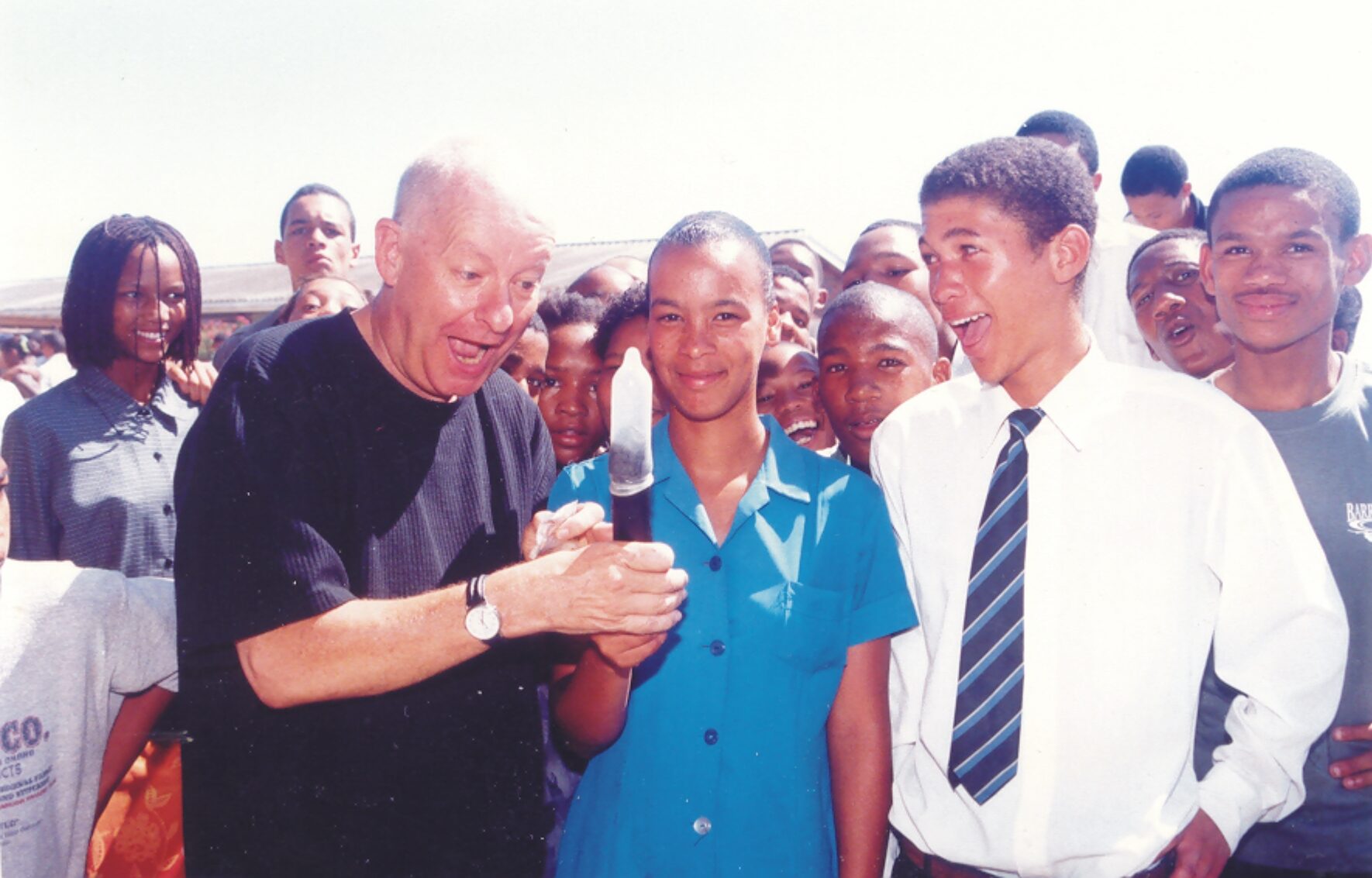
Uys has reached 1,7 million children with his “For Fact Sake” talk at schools and in his straight-talking fashion said it was about overcoming fear.
“As an entertainer I laugh at fear. It (Aids) is a virus, not a tsunami. We have to talk about it,” said Uys.
Uys continued a demonstration of his “For Fact Sake” talk complete with condoms and the F word, the delegates erupted with shocked laughter.
“I say f … at every school, but there is no way to be polite about it. We have to talk about it. Why are we surprised that 10-year-olds have sex? We sell everything with sex. We sell cars with women with tits and men with big bellies,” said Uys.
Uys’s methods may have more shock effect, but the archbishop said Cape Town churches had realised that even though their children had considerable knowledge about HIV and Aids, and about the church’s teaching that God created sex to be enjoyed within marriage, this had little effect on their behaviour.
“Listening led to effective ‘peer education’ programmes where the young people themselves took the lead in promoting healthy lifestyles,” said the archbishop.
The archbishop challenged people of all faiths to “move away from being part of the problem to taking a lead” in overcoming stigma and to change mindsets.
“In 21st century South Africa, too many men are still giving religious reasons to justify unjustifiable patriarchal attitudes within contemporary cultures – whether rooted in Africa or beyond – and defend indefensible actions, which are certainly not what our faiths have at their heart.
“This must change,” said Ndungane.