Archived 2016 Articles about Pieter-Dirk Uys
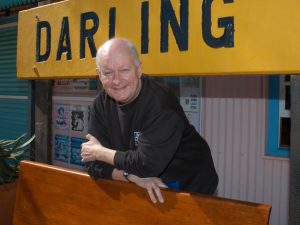
Pieter takes on new role — himself
– Gasant Abarder, Cape Argus, 27 May 2016
“You want an interview with Evita Bezuidenhout? You can! This is one woman I’m very glad I didn’t have to meet face-to-face.”
Pieter-Dirk Uys is sharp to my playful ice-breaker question of arranging an interview with Tannie Evita (watch this space!).
I can’t help feeling guilty because soon Pieter will take on his first stage show, at the age of 70, as himself.
But inevitably, we talk about the darling from Darling. Evita is a role he’s played for more than three decades. Has his alter ego become blurred with his true self?
“I do know her well because she has been with me for over 30 years. One has to build up a history and build up opinions, purely because people kept on asking me the questions like ‘what is her surname?’ She didn’t have a surname. A journalist from an Afrikaans Sunday newspaper asked me in 1982, when Evita had just appeared in Adapt or Dye at the Market Theatre.
“He asked what’s the surname and there was a poster on the wall behind him which read ‘The Seagull – Aletta Bezuidenhout’.
“Her whole history has just been an answer to people’s questions. It had to be entertaining.
“Now she’s a member of the ANC, which is the only logical place for Evita to be because that is power. Opposition is about complaining.
“She is cooking for reconciliation. I have some wonderful SMSes and e-mails from my friends in Luthuli House saying, ‘We saw her in the passage.’ Just because she doesn’t exist doesn’t mean she’s not real!
“She must never be me, then it’s not real. I’m a multi-phrenic, not a schizophrenic… I have all sorts of compartments where emotions can be channelled for characters.
“The only thing I have a problem with is PW Botha because without my hair I look just like PW Botha.
“But I want the women to recognise the woman and the men to respect the man. In fact, Nelson Mandela treated her like a lady. He used to say: ‘Ah, Evita. You look so beautiful.’ Then he’d hug her and whisper in my ear.
“I said to him, after many experiences with him and Evita: ‘President Mandela, every time you see me I’m dressed as a Evita.’
“He said: ‘Don’t worry, Pieter, I know you’re inside’.”
Pieter’s brand of satire has always cut close to the bone and been politically on point. But it’s never about offending to such an extent that it polarises. There are areas he deliberately avoids —- racism and religion, for example.
It’s a minefield that Pieter has very skilfully negotiated over his career and something that has become all the more onerous with the advent of social media.
“I have a definition: 49 percent anger, 51 percent entertainment. The other way around doesn’t work. Then it’s a Penny Sparrow story. The red line of racism is very, very sharp on the ground. That’s the discipline. You don’t cross that for an easy laugh.
“But the fact that people are reacting with such passion shows that satire works. That’s the whole point of it. People say you mustn’t offend. I want to offend… everybody… but not all of the time.
“But racism and sexism and all the -isms are a tremendous minefield that we have to be very careful not to get swallowed up in.
“Social media has become the enema of society — een spuit en die poephol is vol! When you look at all these issues, it is an enormous challenge.
“We have extraordinary freedom of expression, freedom of speech. In its different disguises sometimes you think, please can we not have freedom of expression —- Mr Theunissen, for example.” (That’s Matthew Theunissen, the man who took to Facebook to use the K-word, castigating the government after Fikile Mbalula’s banning of various sports codes from hosting international events.)
But for his next project, and in an almost biopic kind of way, Pieter is delving into very personal terrain. Gone are the masks of Tannie Evita and the other characters he has used as a security blanket over the years.
His new show The Echo of a Noise (Pieter-Dirk Uys unpowdered — at last!) starts at the Theatre on the Bay from May 31.
It’s a stark scene on stage with the spotlight on Pieter sitting on a barstool, wearing his famous black beanie and his “Almost Famous” sweatshirt, opening up about his public and, until now, very private life.
“I am so pleased that I am still alive and sharp enough to balance stories into a 90-minute experience that I can share with people.
“People don’t know… I’ve been very, very private because I’m not the issue here. But you reach a certain time when the audition is over and the disease to please has been cured.”
So we get personal and Pieter starts speaking about his Pa, Hannes Uys, with whom he had a difficult relationship .
It resonates because on the day of this interview my own father, Achmat Abarder, celebrated his 73rd birthday.
My dad, until retiring very recently, was the ultimate provider. Growing up in Mitchells Plain we never wanted for anything, and he and my mom Aleweya created opportunities for my siblings and me to make something of our lives.
My dad, in particular, was so busy being the provider and creating opportunities for us that we seldom connected as father and son.
Even now when I call home and he’ll pick up, he hands over the phone with a “Here’s mom” after exchanging a few pleasantries.
I observe him now connecting with my children and see the father I never connected with on an emotional level. The father that I, despite my crazy life as a journo, want to be.
For Pieter, the father and son relationship was fraught because his choices didn’t meet his dad’s expectations.
“I’ve always been behind something because in the beginning I was poep scared of having anything to say. This is the first time I’m actually without the security blankets.
“It’s the story about me growing up in this country with extraordinary people around me —- my ma, my pa and music, because they were both musicians. This celebration of survival is the story about pa. I never thought I’d write about my pa. We never got on until years later when he suddenly realised I was actually making money doing what I was doing.
“What I noticed with the show, because I do some performances at the Perron as a way of trying out new material, is how many people are sharing with me memories of their parents, memories of tensions with the father.
“My mother committed suicide, so that’s something that doesn’t go away, no matter how much you think time heals. And then up against this government of ooms because my father’s cousin was the first National Party Prime Minister, Dr Malan, so I had family in that laager.
“And so having the family saying: ‘What are you doing here?’ Being gay — also illegal so you’re a criminal because you’re breaking the Immorality Act.
“And finding out apartheid was wrong… and getting to know people that were living on the other side of the moon and they were just down the road.
“The theatre of course did a lot because when you study drama you study humanity through the ages. If you fight it with anger, you get stopped.”
Pieter identifies with my relationship with my dad. Of course, my dad and I don’t have to express our love and respect for each other verbally to know. But these days the emotionally attentive father figure is a much-needed and rare commodity.
Pieter plays the father figure role in a somewhat different way with his activism in the area of HIV/Aids promoting active citizenry and working against voter apathy.
But his latest work may be his most important yet. It’s a vehicle for opening up dialogues on relationships we never had between father and son, as families, as a nation. “Do you have a chance to sit down with your kids as parents and speak to them? I didn’t. There were so many things I wanted to know that I didn’t ask. I was so scared.
“My mother was Jewish. We didn’t know until she died. She came from Berlin and the Nazis chucked her out. But we never, never talked about those things.
“I think it was a generational thing. I think it’s different now. But it’s great to remember and also to remind, especially the kids growing up. I’m finding families are coming to the show. It’s about stories.
“My pa always said, ‘die vloek woorde. Sies! Dis onnodig.’
“He once said to me he comes to the show and I use these swear words and it’s like I stick a finger in his eye. He’s so angry he can’t even see.
“ ‘Why don’t you use that finger to tickle me behind my ear and when I’m having a nice time and when I want to see what is giving me the nice time I turn my head around and my eye will find your finger. Don’t be obvious, find different ways’. That is great advice. It is obviously a big signpost: the death of a parent. That tiny little thing, that little comment, changes your life.”
Pieter doesn’t give himself enough credit. He is effortlessly and naturally funny.
Comedy has always been an important antidote for our most immense challenges as a nation, and Pieter has been constant in our discourse — disarming even the most stoic personalities and ideas with charm.
He is also an optimist about our country and where we’re headed.
“During apartheid everyone understood, even a 6-year-old wore a ‘Free Mandela’ T-shirt. There was no redeeming feature.
“Then I had to speak on behalf of millions of people who didn’t have a voice. Now it’s only my voice, my opinion in this democracy.
“In this country you have the right to disagree, I have to make you laugh at your fear, and when you laugh at your fear you can’t be that frightened of it.
“It can still kill you, but you’ve looked it in the face.
“I must be honest with you, I never thought we whites would get away with apartheid. I thought the hell was going to break loose because there was no apology for what we were doing.
“We, me — I keep on saying I’m as responsible. When I went overseas people said, ja maar… but where’s the cultural boycott? Why am I allowed here? They’d say but you’re different. I’m not different. I’m a white Afrikaner, what makes me different?
“One has to take responsibility for the guilt, but the guilt can also be very creative to make sure it doesn’t happen again.”
“I have to sometimes pull back from the political because one has to. Remember, for every piece of bad news there are two pieces of good news. But they’re not easily found because they’re busy working. Optimism is very important for me.
“But I think we’re in a pretty healthy state as a democracy. After 22 years of coming out of something so terrifying and it will never be perfect. But the biggest problem for me, where we are now, is that we, the citizens, are not doing our homework.
“There is just too many of my generation who are now CEOs or retired and who should be giving thought in leadership and discussion who don’t want to know. That’s why the entertainment industry is important for me to seduce people to come — knowing that I will deliver, but I’ll also give them something to take home with them.
“Something that will make them say ‘Hey, I never thought of that’.”